
Ingredients
Tamanu Oil: What the Research Actually Shows
Tamanu oil has wound-healing and anti-inflammatory data, but most is from labs and animals. Here's what the research actually shows, and who should skip it.
Disclosure — This article may contain affiliate links. We earn a small commission at no extra cost to you when you purchase through our links. This supports our ability to create independent, evidence-based skincare content.
Tamanu oil gets sold as a miracle healer, usually by people who have never read a paper on it. The real picture is smaller and more interesting. There’s genuine lab and animal evidence for wound-healing and anti-inflammatory activity, a thin layer of human data, and a few practical problems (a thick texture, a strong smell, a murky pore-clogging record) that explain why it hasn’t taken over your shelf.
Here’s what the research supports, what it doesn’t, and where a cold-pressed tamanu oil makes sense next to a vitamin C face oil instead of in place of one.
What tamanu oil actually is
Tamanu oil comes from the nuts of Calophyllum inophyllum, a tropical tree that grows across the Pacific islands, Southeast Asia, and coastal India. Traditional medicine in those regions has used the oil on cuts, scars, rashes, and joint pain for a long time. In parts of India you’ll see it called undi or punnai oil.
Cold-pressed, unrefined tamanu is dark green, thick, and syrupy. It smells strongly of roasted nuts, with something closer to curry or tobacco underneath. That color and scent come from a resinous fraction that makes tamanu different from most carrier oils.
Two parts of the chemistry matter:
- The fatty acid base. Like most plant oils, tamanu is mostly triglycerides. Oleic and linoleic acid make up the bulk, in roughly similar proportions, plus palmitic and stearic acid. Exact numbers shift with where the trees grew and how the oil was processed.
- The resin fraction. This is where the interest lies. It includes calophyllolide (a coumarin-like compound) and a group of related molecules called inophyllums. Most of the bioactivity research focuses here.
That second point has a consequence. Refining strips out some of the resin, along with color and smell. So the version that’s easier to live with may be the version with less of what researchers actually studied.
What the research shows
Wound healing
This is tamanu’s strongest claim, and “strongest” needs a qualifier.
The most-cited modern work is a 2015 study in PLoS One by Léguillier and colleagues. They tested several tamanu oils in cell culture. The oils encouraged skin cell migration and proliferation, the basic machinery of closing a wound. They also showed antibacterial activity against Gram-positive bacteria, including Staphylococcus aureus.
Rodent studies on calophyllolide point the same direction, with faster wound closure and signs of improved tissue repair. Older European clinical reports describe use on ulcers, burns, and scars.
Now the caveat. A petri dish isn’t a face, and a rat isn’t a person. Human data exists but it’s small, mostly case series and low-quality trials, with no large randomized controlled study we could find. So the accurate summary is “plausible and promising,” not “proven.”
Anti-inflammatory activity
Calophyllolide shows anti-inflammatory effects in animal models, and extracts reduce inflammatory markers in cell studies. That fits the traditional use on irritated skin.
The gap between mechanism and result is wide. Reducing a marker in a lab doesn’t tell you whether a few drops on your cheek will calm eczema or rosacea. If you have either, start with the routines in our guides on adult facial eczema and damaged skin barrier repair, where the evidence is stronger. Tamanu would be a maybe-extra, not the plan.
Scars and stretch marks
Scar claims are everywhere in tamanu marketing. The biology is reasonable, since wound healing and scar formation are linked processes. But there’s no solid human trial showing tamanu fades mature scars or prevents stretch marks. For what does have support, see our stretch marks evidence review.
What’s missing
No good head-to-head trials against standard options. No long-term safety data on facial use. Little standardization, because “tamanu oil” on a label can mean very different chemistry depending on sourcing and refining. When a brand quotes a study, check whether the study tested the same kind of oil they’re selling. (Often it didn’t.)
The comedogenicity question
Tamanu is frequently listed as a 2 out of 5 on comedogenic scales, meaning moderately likely to clog pores. Treat that number with suspicion. Those scales trace back to rabbit ear assays that don’t translate well to human faces, which we cover in why comedogenic ratings are unreliable. We found no good human trial testing tamanu for pore-clogging either way.
What we can say from the chemistry: tamanu is thick, with a heavy oleic acid contribution. Oleic-rich oils tend to bother acne-prone skin more than linoleic-rich ones, a pattern explained in our piece on linoleic vs oleic face oils. Tamanu splits the difference, so it’s not an automatic no. But it’s also not an oil we’d hand to someone with active breakouts and say “go ahead.”
Practical guidance:
- Oily or acne-prone skin: Skip it on the full face. If you want to test it, try a small area on the jaw for two weeks first. Our guide to face oils for oily, acne-prone skin covers lighter options.
- Dry or normal skin: Reasonable to try, in small amounts.
- Body use: Fewer pore concerns on arms and legs, though the smell follows you everywhere.
The smell problem
Let’s be direct. Unrefined tamanu smells strongly of nuts and something vaguely medicinal. Some people grow to like it. Many don’t, and a product you dread applying is a product that sits in the drawer.
You have three options:
- Accept it. The scent fades within an hour or so on skin.
- Buy refined. Paler and much milder, but with less of the resin fraction. You’re paying for a less characterful oil.
- Dilute it. Mixing a few drops into a plain carrier oil like squalane cuts the smell and the heaviness. (More on squalane if you want a base.)
We’d go with option three for facial use. It’s the least dramatic fix.
Safety: what to check before you start
Tamanu is generally well tolerated in the small amount of human data we have, but “generally” isn’t “universally.”
Patch test first. Dab a little on your inner forearm or behind your ear for a few days. Our patch testing guide walks through it.
Tree nut allergy. Tamanu is a nut-derived oil, and many suppliers advise caution for people with nut allergies. Documented cross-reactions seem uncommon, and the evidence is thin, but if you have a serious nut allergy, ask your allergist before putting it on your face.
Open wounds. This matters because of the marketing. Folk use on cuts doesn’t make a non-sterile cosmetic oil a wound treatment. Don’t apply it to broken, infected, or actively weeping skin without talking to a clinician. Use it on closed, healed skin.
Sun. Nothing here suggests tamanu protects against UV. It’s not a sunscreen, and it’s not a reason to skip one.
Where tamanu fits next to the Kerala Botanics oil
Here’s the question behind this guide: if you already use a face oil, does tamanu belong in the routine?
The two do different jobs. Tamanu is a single botanical oil with a bioactive resin fraction and interesting but preliminary data. Kerala Botanics’ Ayurvedic Vitamin C Face Oil is a formulated product, built around a vitamin C derivative and bakuchiol (a plant-derived retinol alternative, covered in our bakuchiol vs retinol comparison). The brand says its vitamin C form is up to four times more effective and stays in skin cells up to 80 times longer than standard L-ascorbic acid. We haven’t seen independent trials confirming those figures, so treat them as the brand’s claims. For the full ingredient picture, see our ingredient breakdown.
Neither replaces the other. Tamanu doesn’t brighten or deliver an antioxidant, and the Kerala oil isn’t built around wound-repair chemistry.
The Kerala Botanics oil has its own limits. It’s an oil, so oily and acne-prone skin may not love it, and some people find it heavy under makeup. It also has less clinical data than something like SkinCeuticals C E Ferulic, which has been studied far more. But for people who want vitamin C and a retinol alternative in a single oil step, it makes the routine simpler, and the $49 price is fair for what it replaces.
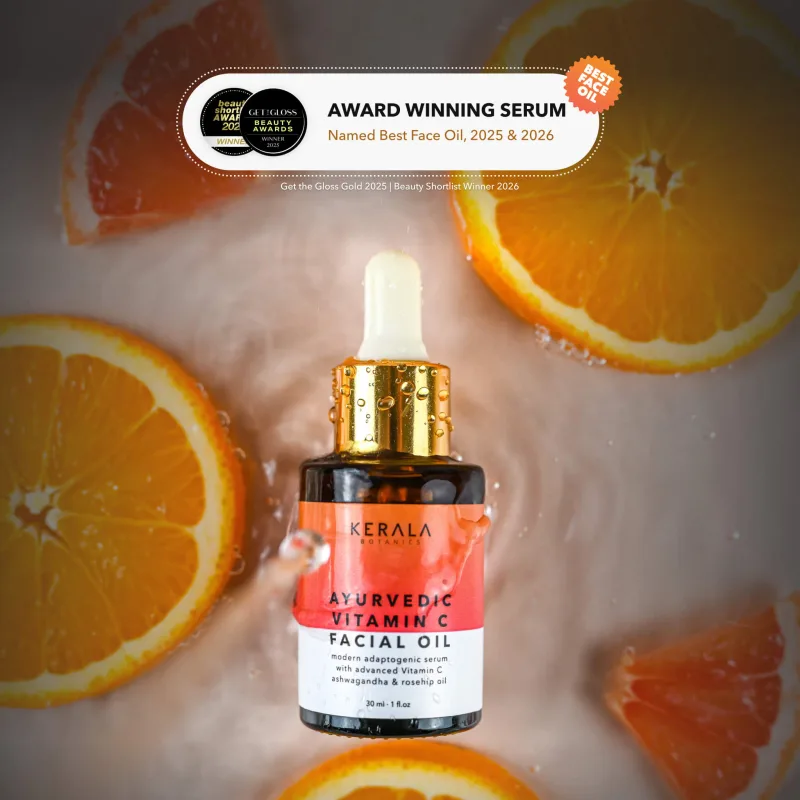
Ayurvedic Vitamin C Face Oil
Kerala Botanics
$49
★★★★☆
A sensible way to combine them
Layering two oils isn’t complicated, but it benefits from restraint. We haven’t seen any research on using these two together, so this is practical judgment, not evidence.
- Morning: Use the Kerala Botanics oil as your vitamin C step, followed by sunscreen.
- Evening: Use the Kerala oil on its own, or put one or two drops of tamanu (diluted if the smell bothers you) on dry patches or healed blemish marks only.
- Don’t stack both over your whole face. Two heavy oils at once is how people end up with congested skin and no idea which one caused it.
Not sure how much oil to use or in what order? Our guide on how to use facial oils covers the basics, and the 3-in-1 oil routine shows how one oil can cover several steps. If you’d rather not add a second bottle at all, that’s a perfectly good call. Tamanu is optional.
How to buy tamanu oil without wasting money
Because the category is loosely regulated, labels are where you separate good bottles from filler.
- Look for the INCI name: Calophyllum inophyllum seed oil. If the ingredient list is just “tamanu blend,” move on.
- Check for cold-pressed and unrefined if you want the resin fraction. Expect dark green and a strong smell. Pale, mild-smelling oil is likely refined.
- Prefer opaque or dark glass. Light and heat degrade plant oils. Our guide on storing skincare properly has the details.
- Ignore the price-as-quality shortcut. Expensive tamanu isn’t necessarily better. We’d rather see a harvest date or batch information than a luxury box.
- Discard it if it smells sharp or like old crayons. That’s rancidity, and no resin fraction is worth that.
If you’d rather skip single oils entirely, our roundup of the best facial oils of 2026 covers formulated options.
Putting it all together
Tamanu oil isn’t snake oil, and it isn’t a miracle. The lab and animal evidence for wound-healing, antibacterial, and anti-inflammatory effects is real. The human evidence is small. The comedogenicity record is unclear, the smell is a genuine dealbreaker for many people, and the nut-allergy caution is worth taking seriously.
What we’d tell a friend:
- Dry, non-acne-prone skin: Worth a patch test and a small trial, mostly for targeted dry or healed areas.
- Oily or breakout-prone skin: Skip it, or test on a small area first.
- Already using a vitamin C oil: Keep that as your anchor. Tamanu is an extra, not a swap. The Kerala Botanics oil handles the vitamin C and bakuchiol work, and tamanu, if you add it, handles spot care.
- Open wounds, eczema flares, serious nut allergy: Talk to a clinician before using it.
The verdict: a niche oil with a respectable mechanism and a thin evidence base. Interesting, not essential.