
Ingredients
What's Actually in Kerala Botanics Ayurvedic Vitamin C Face Oil
A line-by-line teardown of the 19 ingredients in Kerala Botanics' vitamin C face oil, from the actives that work to the citrus oils that just smell nice.
Disclosure — This article may contain affiliate links. We earn a small commission at no extra cost to you when you purchase through our links. This supports our ability to create independent, evidence-based skincare content.
Most “ingredient breakdown” content on brand websites is really just marketing copy with the word “clinically” sprinkled in. Nobody tells you which ingredient is doing the work and which one is there because it smells nice in a jar. So we pulled the full INCI list for Kerala Botanics’ Ayurvedic Vitamin C Face Oil and went through it the way we’d read any formulation sheet: in order, by concentration, no assumptions.
Nineteen ingredients, total. That’s a lean list for a face oil trying to do this much — vitamin C treatment, retinol alternative, and moisturizer in one bottle. Some of that leanness is good formulation discipline. Some of it means a few ingredients are doing double duty as both an active and a scent note, which matters if you’re the type of person who breaks out from fragrance.
Here’s what’s actually in the bottle, and what each thing is realistically doing for your skin.
How to Read This Label in the First Place
INCI lists are ordered by concentration, highest to lowest, down to about the 1% mark — after that, order gets murky and companies can arrange the last handful more or less however they want. So the first five or six names on this label tell you what the product mostly is. The back half tells you what it’s flavored with.
That’s a useful lens for any face oil, not just this one. If you want the longer version of how to parse a label like a formulator instead of a shopper, we’ve got a full guide on reading skincare ingredient labels.
The Carriers: What’s Actually Holding This Together
Helianthus Annuus (Sunflower) Seed Oil, Simmondsia Chinensis (Jojoba) Seed Oil, Squalane, Rosa Canina (Rosehip) Fruit Oil, Prunus Amygdalus Dulcis (Sweet Almond) Oil
These five sit at the top of the list, which tells you the base of this product is a blend rather than a single hero oil. That’s smart, actually. Sunflower and jojoba are both linoleic-acid-leaning, which means they’re less likely to sit heavy or clog pores than a straight oleic oil would. If you want the mechanism behind why that ratio matters so much for breakout-prone skin, we’ve written about it directly in our linoleic vs. oleic face oil guide.
Squalane is the ingredient doing the most quiet, unglamorous work here. It’s biomimetic — it resembles the lipid your own skin already produces — so it absorbs fast and plays well with basically every skin type. We’ve covered why it’s become the default carrier oil across the industry in our squalane guide. Nothing exciting to report. It just works, consistently, which is more than most ingredients on this list can claim.
Rosehip oil is the one with an actual reputation to interrogate. It’s often marketed as “natural retinol,” which is a stretch — it doesn’t have meaningful retinoid activity on its own. What it does have is a solid vitamin A precursor content and a fatty acid profile that supports barrier function, which is a legitimate reason to include it. We break down what the research actually supports (and where the marketing outruns it) in our rosehip oil deep dive.
Sweet almond oil rounds out the carrier blend as a straightforward emollient. It’s not doing anything the other four aren’t already covering, but it’s not there for scent either — it’s filler in the neutral sense, texture and slip, nothing more.
Verdict on the carriers: all five earn their place. None of them are dead weight, and the linoleic-leaning blend means this formula is more wearable across skin types than a single heavy oil would be.
The Actives: What’s Actually Doing Something
Ascorbyl Tetraisopalmitate
This is the vitamin C in the formula, and it’s a deliberate choice, not a budget one. Unlike L-ascorbic acid, ATIP is oil-soluble and far more stable — it doesn’t oxidize into that orange, useless mess the way water-based vitamin C serums do. Kerala Botanics’ marketing claims it “stays in skin cells up to 80x longer” than standard L-ascorbic acid; we haven’t seen independently published data at that exact multiplier, so treat it as a directional claim rather than a verified number. What’s well-established is that ATIP is more stable and better tolerated by sensitive skin than L-ascorbic acid. We go deep on the actual mechanism in our ascorbyl tetraisopalmitate guide, and if you’re trying to decide between an oil-based and water-based vitamin C format generally, our oil-soluble vs. water-soluble vitamin C comparison walks through the tradeoffs.
Bakuchiol
The plant-derived retinol alternative, and by this point a fairly well-studied one. The evidence isn’t as deep as the multi-decade tretinoin literature, but the head-to-head trials that exist show comparable improvement in fine lines and photoaging with less irritation. We’ve covered the actual data in our bakuchiol vs. retinol breakdown. Its inclusion here is genuinely useful — it’s the reason this oil can plausibly replace a retinoid step for people who can’t tolerate one, which we discuss in more detail in our algae retinol vs. bakuchiol vs. retinol comparison.
Phyllanthus Emblica (Amla) Fruit Extract
Amla, or Indian gooseberry, is naturally high in vitamin C and polyphenols, and it’s been used in Ayurvedic formulations for centuries — though “used for centuries” and “clinically proven” are two different sentences. The extract form here contributes antioxidant activity that complements the ATIP rather than duplicating it. It’s a reasonable inclusion, not a redundant one. Our amla guide covers what the extract can and can’t do on its own.
Withania Somnifera (Ashwagandha) Root Extract
Ashwagandha gets talked about mostly as a stress-adaptogen supplement, and the topical evidence is thinner than the ingestible evidence. What data exists points to some anti-inflammatory and antioxidant activity when applied to skin, which is a defensible reason to include it in an antioxidant-forward oil. It’s not the headline ingredient, and it shouldn’t be marketed as one. Read the actual research in our ashwagandha for skin piece.
Rubia Cordifolia (Manjistha) Root Extract
Manjistha is the Ayurvedic ingredient most associated with evening out tone and calming post-inflammatory redness. The mechanism isn’t fully mapped in Western dermatology literature, but there’s enough traditional and preliminary evidence to justify its spot here, especially in a formula that’s positioning itself around brightening. We cover what’s known (and what’s still folklore) in our manjistha guide.
Centella Asiatica Leaf Extract
Centella — the “cica” ingredient that took over Korean skincare — has some of the better clinical support on this entire list. It’s shown real barrier-repair and anti-inflammatory effects across multiple trials, which makes it a smart inclusion in a formula that’s also layering on a retinol alternative and an active vitamin C ester. It’s doing calming work that offsets whatever mild irritation the actives might cause. Our centella asiatica guide has the full rundown.
Tocopherol (Vitamin E)
Not flashy, but functionally important. Vitamin E stabilizes oil-based formulas and works synergistically with vitamin C — the two extend each other’s antioxidant activity, which is the entire premise behind formulas like SkinCeuticals CE Ferulic. It’s a low-dose, high-utility ingredient. Nothing to critique here.
Verdict on the actives: this is a genuinely active formula, not a fragrance oil dressed up with Sanskrit names. ATIP, bakuchiol, and centella are the three doing the heaviest lifting. Amla, ashwagandha, and manjistha are supporting players with real but more modest evidence behind them — worth including, not worth building a marketing claim around individually.
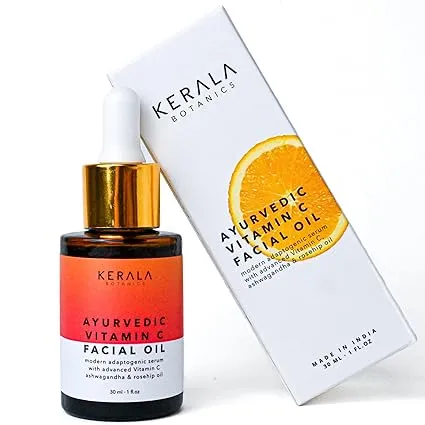
Ayurvedic Vitamin C Face Oil
Kerala Botanics
$49
★★★★☆
The Aromatics: What’s Here for Scent, Not Science
Rosmarinus Officinalis (Rosemary) Leaf Extract
Technically this can act as a mild natural preservative and antioxidant, so it’s not purely decorative. But at the low concentration typical in a formula like this, its main contribution is scent character, not shelf-life insurance.
Citrus Aurantium Dulcis (Orange) Peel Oil, Citrus Paradisi (Grapefruit) Peel Oil, Rosa Damascena Flower Oil
These three are here to make the oil smell like something you’d want to put on your face twice a day, not because orange peel oil is exfoliating your skin or grapefruit is brightening anything. Rose oil has some documented mild anti-inflammatory and skin-barrier benefits in isolated studies, which we cover in our rose oil guide, but the concentration in a product like this is a fragrance dose, not a treatment dose. Don’t buy this oil expecting the rose to do therapeutic work. It’s there for the ritual, which — to be fair — is part of the point of Ayurvedic formulation philosophy, something we get into in our Ayurvedic skincare modern guide.
Limonene, Linalool, Citral
These three are naturally occurring constituents of the citrus and rose oils above, not separately added ingredients. They’re also three of the most common fragrance allergens flagged in EU labeling regulations. If you have a known sensitivity to fragrance, or reactive, eczema-prone skin, these are the names to scan for on any product — including this one.
Verdict on the aromatics: honest about what they are. None of them are pretending to be actives. The concern isn’t efficacy, it’s tolerance — which brings us to the question everyone eventually asks about a citrus-scented leave-on oil.
The Citrus Photosensitivity Question, Answered
Here’s the actual concern, stated plainly: certain citrus oils contain furanocoumarins, compounds that can react with UV light and cause phototoxic reactions — think unexpected redness or hyperpigmentation in the exact shape of where you applied the product. Bergamot oil is the classic offender, historically strong enough to cause visible burns in old-school perfume formulations.
Grapefruit and sweet orange peel oils are weaker phototoxic risks than bergamot, but they’re not zero. Cold-pressed grapefruit peel oil in particular can carry a low furanocoumarin load. In the concentration used in a leave-on facial oil — a few percent at most, blended with a dozen other ingredients — the realistic risk for most people is low. It’s not nothing, though, and “low risk” isn’t the same as “no risk,” especially for melasma-prone or very fair, reactive skin.
The practical fix is simple: use this oil at night. That sidesteps the entire question, since the phototoxic mechanism requires UV exposure to activate. If you want to wear it during the day, wear sunscreen over it and don’t skip reapplication — the standard advice for any oil containing citrus, not just this one. We go deeper into the furanocoumarin mechanism and which oils actually pose meaningful risk in our citrus essential oils and photosensitivity guide.
Putting It All Together
Strip away the branding and this is a fragranced facial oil with three genuinely active ingredients — ascorbyl tetraisopalmitate, bakuchiol, and centella — supported by three lower-evidence Ayurvedic extracts and a competent, linoleic-leaning carrier blend. The rose, orange, and grapefruit oils are along for scent, not treatment, and the trace furanocoumarin content is a nighttime-use consideration rather than a reason to avoid the product outright.
For $49, you’re getting a formula that could plausibly replace a vitamin C serum, a retinol alternative, and a facial oil — which is the whole pitch, and it mostly holds up on paper. It won’t out-perform a dedicated, high-percentage bakuchiol serum or a stabilized 15% L-ascorbic acid formula in a head-to-head. It’s also not trying to. It’s trying to be the one bottle that does enough of each job well, at night, without you needing three separate products.
If your skin is oily and reactive to fragrance, this isn’t the pick — go look at our oily skin vitamin C roundup instead. If you want the full hands-on performance review rather than just the ingredient teardown, we tested it over several weeks and wrote up the results in our Kerala Botanics face oil review.