
Routines
Dosha Skincare: Does Vata, Pitta, Kapha Typing Hold Up?
Ayurveda's dosha system maps surprisingly well to dry, sensitive, and oily skin—but only as a starting heuristic. Here's what holds up and what doesn't.
Disclosure — This article may contain affiliate links. We earn a small commission at no extra cost to you when you purchase through our links. This supports our ability to create independent, evidence-based skincare content.
Ayurveda has a 3,000-year head start on skin typing. The three-dosha system — Vata, Pitta, Kapha — predates the FDA, the cosmetic chemist, and the 12-step routine by roughly 29 centuries. So it’s worth asking whether it actually maps onto what we understand about skin biology today, or whether it’s useful only as a wellness aesthetic.
The honest answer is: both. Parts of it are surprisingly good shorthand. Parts of it are not diagnosis, and shouldn’t be treated as one.
Here’s where the framework earns its keep, and where it runs out of road.
What the Dosha System Actually Claims
In Ayurvedic medicine, the three doshas — Vata (air/ether), Pitta (fire/water), Kapha (earth/water) — describe constitutional types that govern everything from digestion to temperament to skin. You can be predominantly one dosha, or a combination. Your dosha influences which imbalances you’re prone to, including skin conditions.
Crucially, the Ayurvedic framework isn’t just describing what’s happening to your skin right now. It’s describing a baseline constitutional tendency that shapes how your skin behaves over time. That distinction matters when we try to map it onto modern skin typing.
Modern Western skincare uses five categories: dry, oily, combination, normal, and sensitive. Dosha typing uses three, but they’re describing overlapping territory from a different angle. The overlap is real — and so are the gaps.
For a deeper look at what Ayurvedic tradition actually got right from a modern skincare perspective, the guide to modern Ayurvedic skincare is worth reading alongside this one.
Vata: The Dry, Thin-Skinned Type
Vata skin is described as dry, fine-pored, prone to flakiness, and quick to show dehydration lines. In cold or windy weather, it deteriorates fast. The Ayurvedic explanation is an excess of air — movement without moisture. The Western translation is simple: compromised lipid barrier, low sebum production, transepidermal water loss running high.
This maps cleanly. Vata = dry/dehydrated skin, often with a thin or sensitized barrier.
What this means practically: Vata types benefit from occlusive-heavy moisturizers, fatty acids (ceramides, squalane), and gentle cleansers that don’t strip. The priority is keeping water in — humectants layered under occlusives, not humectants alone. Heavy exfoliation is a bad idea. So is fragrance, which can push an already-reactive barrier further toward compromise.
If your skin fits this profile, barrier-adaptive moisturizers and ceramide-rich formulas are worth prioritizing before anything actives-forward.
Pitta: The Reactive, Redness-Prone Type
Pitta skin is described as fair to medium, prone to flushing, heat-sensitive, and likely to develop redness, rashes, or inflammation when stressed. The Ayurvedic framing is excess fire — too much heat, too much reactivity. Westernize that and you get: sensitive skin with a tendency toward rosacea-like responses, contact reactions, and barrier disruption from actives.
This one also maps reasonably well. Pitta ≈ sensitive/reactive skin. The fire metaphor isn’t far off from what actually happens physiologically — an upregulated inflammatory response, blood vessels close to the surface, a skin barrier that’s permeable to irritants.
What this means practically: Pitta types need fragrance-free formulas, minimal actives (or very low-concentration entry points), and anti-inflammatory ingredients. Centella asiatica, colloidal oatmeal, beta-glucan, and azelaic acid at low doses are all reasonable here. Avoid anything that generates heat in the skin — physical scrubs, high-concentration vitamin C, strong retinoids out of the gate.
Niacinamide is useful for this profile. So is consistent, daily SPF — Pitta skin tends to react badly to UV, and cumulative sun exposure makes the inflammatory tendency worse. See our rosacea-friendly routine for a full ingredient rundown.
Kapha: The Oily, Congestion-Prone Type
Kapha skin is described as thick, oily, large-pored, and prone to congestion and dullness. The Ayurvedic reading: excess earth and water, meaning heaviness, slowness, accumulation. In modern terms: high sebum production, sluggish cell turnover, comedone formation.
Again, the overlap is real. Kapha ≈ oily/combination skin, especially if it trends toward blackheads rather than inflammatory acne.
What this means practically: Kapha types benefit from regular exfoliation (BHAs like salicylic acid are the obvious fit — oil-soluble, follicle-clearing), lightweight hydration, and gel or water-based formulas rather than creams or heavy oils. The goal is keeping the surface clear without stripping — because over-stripping oily skin just triggers a compensatory sebum spike.
Zinc PCA is worth considering here; the evidence for oil control is reasonable. Heavy occlusives are generally not the move.
Where the Framework Actually Helps
The dosha system is useful as a starting heuristic. If someone walks you through the quiz and you land firmly in Vata, there’s a reasonable chance you’re dry and barrier-compromised, and the recommended approach — rich moisturizers, gentle actives, avoiding harsh cleansers — is genuinely good advice for that skin type.
The same logic applies to the other two. As a shorthand for “here’s the direction to go,” it works.
It also has one distinct advantage over standard Western skin typing: it considers environmental and seasonal context. Ayurveda has always accounted for the fact that your skin behaves differently in winter versus summer, in dry climates versus humid ones. Modern skincare is catching up to this idea — slowly. The seasonal skincare transition framework essentially covers the same ground, just without the Sanskrit.
Where It Doesn’t Hold Up
Here’s the problem. Dosha typing is a constitutional model, not a diagnostic one. It can’t identify:
- Fungal acne (Malassezia), which mimics regular breakouts but requires completely different treatment
- Hormonal acne, which has a distinct pattern independent of dosha
- Contact dermatitis, which is a specific immune response, not a Pitta excess
- Perioral dermatitis, which can look like sensitive Pitta skin but has specific triggers and contraindications
- Barrier damage from over-exfoliation, which can make oily Kapha skin suddenly look dry and Vata-like
The risk of over-relying on dosha typing is that you might spend months treating the wrong thing. Someone who tests as Pitta might have rosacea and need a dermatologist, not just calming serums. A Kapha-presenting breakout pattern might be fungal and require antifungal treatment, not more BHA.
Dosha typing is a starting point for building a routine. It’s not a substitute for diagnosis when something isn’t responding.
If you’re dealing with persistent, unexplained skin changes, the guide to diagnosing fungal acne and the broader skin barrier burnout article are good places to rule things out before assuming the issue is constitutional.
Combination Types: The Framework Gets Messier
Most people aren’t pure Vata, Pitta, or Kapha. They’re combinations — Vata-Pitta, Kapha-Pitta, Tri-dosha. In Ayurvedic practice, this is handled through seasonal adjustments and lifestyle considerations. In skincare terms, it means your skin is combination or context-dependent.
An oily T-zone with dry cheeks (classic combination skin) doesn’t map neatly to any single dosha. A Kapha-Pitta would fit, loosely — oily and congestion-prone but also reactive to the wrong products. The framework bends here, which is fine, but it also reveals that the three-bucket system has the same limitation as the five-bucket Western version: real skin doesn’t stay in its lane.
The useful move for combination skin is to treat zones separately rather than looking for a single dosha answer.
Products That Make Sense Within This Framework
For Vata types looking for a simplified routine that covers hydration and treatment in fewer steps, the Kerala Botanics Ayurvedic Vitamin C Face Oil is a reasonable consideration. It’s an oil-based format, which suits dry skin well, and it combines a stabilized form of vitamin C with bakuchiol — a plant-based compound with some evidence behind it as a retinol alternative (see our full bakuchiol breakdown). The Ayurvedic formulation angle is genuine, not just branding.
That said, face oils aren’t ideal for every skin type. Kapha types and people prone to congestion may find oil-based treatments work against them. And if you’re primarily Pitta, you’d want to confirm none of the botanical components are reactive for your skin before committing. The bakuchiol component is generally well-tolerated, but any oil-heavy formula can be occlusive in ways that don’t suit reactive skin.
The honest pros: versatile format, replaces multiple steps, bakuchiol is a legitimate ingredient. The honest cons: less clinical data than something like CE Ferulic, the oil format genuinely doesn’t suit oily or acne-prone skin, and it may sit heavily under makeup.
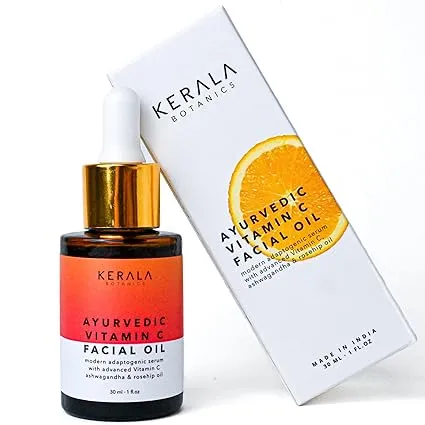
Ayurvedic Vitamin C Face Oil
Kerala Botanics
$49
★★★★☆
For more Ayurvedic-adjacent ingredients and how they perform under modern scrutiny, the amla guide and the manjistha overview cover two that actually have some evidence behind them.
Putting It All Together
The dosha framework isn’t pseudoscience — it’s a premodern typology that happens to overlap meaningfully with modern skin categories. Vata aligns with dry/dehydrated skin. Pitta aligns with sensitive/reactive skin. Kapha aligns with oily/congestion-prone skin. The ingredient recommendations that follow from each dosha are, on the whole, reasonable.
Use it as a starting point for routine building. It’s a useful lens, especially if you’re new to skincare or coming from an Ayurvedic tradition and want to connect the two frameworks.
Don’t use it to self-diagnose persistent skin conditions. And don’t let it replace the boring, unglamorous step of actually patch-testing products and watching how your skin responds over weeks, not days.
The skin doesn’t care about philosophy. It cares about what you put on it.