
Routines
How to Use an Ayurvedic Vitamin C Face Oil
A practical guide to using an Ayurvedic vitamin C face oil — drop count, damp vs. dry skin, routine order, and how to avoid pilling under makeup.
Disclosure — This article may contain affiliate links. We earn a small commission at no extra cost to you when you purchase through our links. This supports our ability to create independent, evidence-based skincare content.
Most people treat a face oil like a final, optional flourish — three drops pressed on top of everything else, mostly for shine. That’s a reasonable way to use a plain jojoba or squalane oil. It’s the wrong way to use an Ayurvedic vitamin C face oil, because you’re not just sealing in moisture. You’re delivering an active ingredient, and actives have rules about timing, skin condition, and what goes on top of them.
This guide walks through the specifics: how many drops, damp skin or dry, where it lands in your AM and PM routine, and — the part almost nobody explains correctly — why rushing to makeup or sunscreen right after application is the single most common reason these oils pill or feel greasy.
Why This Isn’t Just “Another Face Oil”
A standard face oil is emollient. It sits on the surface, smooths the skin’s texture, and slows water loss. An Ayurvedic vitamin C oil, like the one from Kerala Botanics, is doing that plus delivering an oil-soluble vitamin C derivative and bakuchiol, a plant-based retinol alternative, into the skin itself.
That distinction matters for application. Oil-soluble vitamin C esters penetrate the lipid layers of the stratum corneum differently than the L-ascorbic acid in a water-based serum — generally more slowly, with less irritation, but also with more sensitivity to how much oil is on the skin’s surface competing for absorption. Pile on other products first and you’re diluting the delivery. Skip the rest of your routine and rely on the oil alone, and you’re probably under-moisturizing if your skin runs dry. There’s a middle path, and it’s not complicated once you know it.
If you’re new to face oils generally, our guide on using facial oils covers the basics. This one is specific to the vitamin C + bakuchiol combination.
How Many Drops You Actually Need
Two to four drops. That’s it for the whole face.
People consistently overapply oils because the bottle doesn’t have the built-in portion control of a pump serum. Four drops warmed between your palms covers the entire face and neck with room to spare. If you’re using more than that and still feeling like you need another layer, the problem probably isn’t drop count — it’s technique. Press, don’t rub. Rubbing pushes the oil around instead of into the skin, and it’s why people end up reaching for extra.
For reference, this is roughly the same amount you’d use with any concentrated facial oil. Grape seed oil and other lightweight formulas follow the same math. An Ayurvedic vitamin C oil is a little richer than that, so if anything, err toward two drops and build up rather than starting heavy.
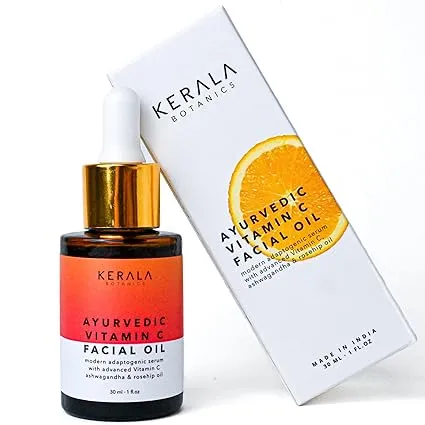
Ayurvedic Vitamin C Face Oil
Kerala Botanics
$49
★★★★☆
Pros: Combines a longer-lasting vitamin C derivative with bakuchiol in one step, so it functions as serum, treatment, and moisturizer at once. Formulated with Ayurvedic botanicals rather than a bare-bones actives list. Genuinely simplifies a routine for people who don’t want five bottles on the counter.
Cons: Less clinical trial data behind it than something like SkinCeuticals C E Ferulic, so you’re trusting mechanism and ingredient research more than head-to-head studies. The oil format isn’t ideal if your skin runs oily or acne-prone — face oils for oily, acne-prone skin is worth a read before you buy. Can feel heavy under makeup if you don’t give it time to settle (more on that below).
Verdict: For dry-to-normal skin that wants a lower-effort routine, this earns its place. If you already run five active steps and love layering, you won’t need it as much.
Damp Skin or Dry Skin? It Matters More at Night Than in the Morning
Applying a face oil onto damp skin is a real technique, not a wellness myth — it’s the basis of the “slugging with oil” approach, where water on the skin gets trapped under the oil layer and slows evaporation, temporarily plumping the surface. That’s genuinely useful at night, when you’re not worried about oil sitting on your face for eight hours under makeup.
In the morning, damp application works against you. You’re about to layer sunscreen, possibly makeup, and you don’t want extra water content changing how those products set. Apply this oil to fully dry skin in the AM, and onto slightly damp skin (pat, don’t drench) at night if your skin runs on the dehydrated side. This is the same logic behind Abhyanga, the Ayurvedic oil massage tradition this product borrows from — oil on prepared, slightly moist skin absorbs and massages in more evenly than oil on bone-dry skin.
If you’re not sure whether your skin is dry or dehydrated, that distinction actually changes this decision. Our dehydrated vs. dry skin guide breaks down how to tell the difference and why it changes your whole routine, not just this one step.
Where It Sits in the Order
This is where most people get it backward. An oil-based vitamin C product goes near the end of your routine — after water-based serums, before (or in place of) your moisturizer.
Oils are occlusive. Applied first, they’ll block water-based actives from penetrating at all. Skincare order generally moves thinnest-to-thickest, wateriest-to-oiliest, and that rule doesn’t bend for this product just because it’s delivering vitamin C. If you’re using other treatments, they still go underneath. For the full logic behind why order changes absorption, our layering guide is the reference we’d point you to.
Morning Routine
- Cleanser
- Any water-based treatment (niacinamide, a hydrating toner, etc.)
- Two to four drops of the vitamin C oil, pressed into dry skin
- Wait for the absorption window (next section)
- Sunscreen
Night Routine
- Cleanser (double cleanse if you wore sunscreen or makeup — see our double cleansing guide)
- Any exfoliating acid or water-based treatment, if that’s your night for it
- Two to four drops of the oil, applied to slightly damp skin
- That’s it — the oil replaces your moisturizer step for most skin types
If you’re used to a five- or six-product routine, this can feel almost too simple. That’s the point of a 3-in-1 oil — it’s built to replace, not stack on top of, your existing steps. If the concept feels unfamiliar, this piece on one-oil routines explains the reasoning in more depth.
The Absorption Window: How to Stop It Pilling Under Makeup
Here’s the part that actually causes most of the complaints about vitamin C oils feeling heavy or pilling under foundation: people aren’t waiting long enough.
Oils absorb more slowly than water-based serums, full stop. A hyaluronic acid serum can be makeup-ready in sixty seconds. An oil needs closer to five to ten minutes to fully settle into the skin’s surface. Apply your sunscreen or foundation before that window closes, and you’re mixing an unabsorbed oil layer with a separate product layer — that’s the pilling you’re seeing, and it’s mechanical, not a sign the product is wrong for your skin.
The fix is boring but it works: apply the oil, do something else for five to ten minutes (brush your teeth, deal with your inbox, whatever), then move to sunscreen or makeup. If your skin still feels tacky or slick after ten minutes, you’re using too much oil, not too little time. Go back to two drops.
This absorption delay is also why the oil format isn’t automatically better or worse than a traditional vitamin C serum — it’s just a different tradeoff. If you want the full comparison, vitamin C serum vs. vitamin C oil covers texture, stability, and absorption speed side by side. Ascorbyl tetraisopalmitate and similar oil-soluble esters — explained in more detail here — tend to be gentler on sensitive skin than L-ascorbic acid, but that gentleness comes with a slower timeline.
Layering Under Sunscreen
Once the oil has absorbed — genuinely absorbed, not just sitting there looking matte — sunscreen goes on top without issue. The oil functions as your moisturizer at that point, and sunscreen is meant to go over moisturizer, not under it.
Two things to watch for. First, mineral sunscreens can grab onto residual oil and go patchy or streaky if you rush the timing, more so than chemical formulas. If you use a zinc-based sunscreen, give the oil the full ten minutes before you apply it. Second, vitamin C and bakuchiol don’t provide sun protection on their own, and bakuchiol in particular has some early data suggesting mild photosensitizing potential similar to retinoids — reason enough to treat sunscreen as non-negotiable, not optional, on mornings you use this product. How much sunscreen to actually apply is worth a refresher if you’ve been eyeballing it.
A Few Mistakes Worth Naming
Using it as an extra step instead of a replacement. If you’re layering this oil on top of a separate moisturizer and a separate vitamin C serum, you’ve built a five-step routine out of a product designed to cut it down to two. That’s not wrong, exactly, but you’re paying for redundancy.
Applying it before other actives. Oil first blocks everything that comes after it. Always last, or close to it.
Judging it in a week. Bakuchiol’s effects on texture and fine lines build gradually, similarly to retinol, just with a gentler side-effect profile. Bakuchiol vs. retinol has the timeline comparison if you’re curious how the two stack up.
Skipping the patch test. Ayurvedic formulas often include botanical extracts beyond the headline ingredients, and “natural” doesn’t mean “universally tolerated.” Run a patch test before your first full application — here’s how to do it properly.
Putting It All Together
An Ayurvedic vitamin C face oil isn’t hard to use, but it does ask you to unlearn a few habits from your serum-and-moisturizer routine. Two to four drops, applied last, pressed rather than rubbed in. Dry skin in the morning, slightly damp skin at night. Give it five to ten full minutes before sunscreen or makeup — that window is what separates a smooth finish from a pilled one. And resist the urge to stack it on top of your existing products; it’s built to replace them, not join them.
If you want a deeper look at how this specific formula holds up over weeks of use, our full Kerala Botanics review covers texture, scent, and results in detail. And if the whole Ayurvedic angle is new territory for you, our primer on what the tradition actually gets right is a good next stop.