
Ingredients
Does Coenzyme Q10 Do Anything for Skin?
Does coenzyme Q10 do anything for skin? We break down ubiquinone vs ubiquinol, penetration limits, and what the modest research actually shows for fine lines.
Disclosure — This article may contain affiliate links. We earn a small commission at no extra cost to you when you purchase through our links. This supports our ability to create independent, evidence-based skincare content.
Coenzyme Q10 probably does something for skin, but not much, and not in the way the packaging suggests. The evidence is small, short, and often funded by the companies selling the creams. That doesn’t make it useless. It means CoQ10 belongs in the “nice if it’s already in your moisturizer” category, not the “worth building a routine around” one.
Here’s what we know, what we don’t, and where your money is better spent.
What CoQ10 actually is
Coenzyme Q10 is a molecule your body makes on its own. Every cell uses it to produce energy, and it also works as an antioxidant, neutralizing unstable molecules (free radicals) before they damage nearby structures.
Skin has it too. Levels appear to drop with age and with UV exposure, which is the origin story for nearly every CoQ10 product. Levels go down, so put it back. It’s a tidy idea.
The trouble is that “your skin has less of it” doesn’t automatically mean “rubbing it on restores it.” Plenty of things decline with age. Whether a topical version reaches the right place, in the right form, at a useful dose, is a separate question.
Ubiquinone vs ubiquinol
You’ll see two names on labels. They’re the same molecule in two states.
| Ubiquinone | Ubiquinol | |
|---|---|---|
| State | Oxidized | Reduced (electrons added) |
| Color | Yellow-orange | Pale, nearly colorless |
| Stability | More stable | Oxidizes easily |
| Antioxidant activity | Must be converted first | Active form |
| Where you’ll find it | Most creams and serums | Supplements, a few skincare launches |
Ubiquinol is the “active” antioxidant. Ubiquinone is the one that survives a jar sitting on your bathroom shelf. Skin cells can reportedly convert ubiquinone to ubiquinol using their own enzymes, which is why most formulators stick with the sturdier form.
So when a brand advertises ubiquinol as superior, that’s partly true in a test tube. In a real product it has to stay ubiquinol through manufacturing, shipping, and months of opening the lid. That’s a hard ask. If a formula doesn’t say how it protects the ingredient, treat the claim with caution.
One practical note: ubiquinone is naturally orange. A CoQ10 cream with a faint peach or yellow tint is normal. A cream that’s pure white and claims lots of CoQ10 has either very little or something else going on.
The penetration problem
Skin is built to keep things out. The top layer, the stratum corneum, is a tight brick-and-mortar structure of dead cells and lipids. As a rough rule, molecules above about 500 daltons struggle to get through it.
CoQ10 weighs in around 863 daltons. It’s also very fat-loving, which makes things worse in a way that’s easy to miss. Oil-soluble helps it dissolve into the skin’s surface lipids, but it tends to stay there rather than move into the water-rich layers underneath.
There is some data pointing the other way. A frequently cited 1999 study from a skincare manufacturer found CoQ10 applied to skin showed up in the deeper epidermis and reduced oxidative activity there. That’s real, and it’s the reason the ingredient never died out. But it was an early, company-linked study, and “detectable in the epidermis” is a long way from “reaches the mitochondria in useful amounts.”
Delivery technology can help at the margins. Nanoemulsions, liposomes, and nanoparticles are all being studied. We covered the general question in our piece on liposomal delivery in skincare, and the short version applies here: the lab results are encouraging, and the consumer products rarely disclose enough to know which ones deliver.
The mitochondria claim
This is the one that sounds most scientific, and where the gap between claim and evidence is widest.
The pitch goes: CoQ10 sits in the mitochondria, your cells’ power plants. Mitochondria slow with age. So CoQ10 “re-energizes” aging skin cells.
Each step is true on its own. CoQ10 does sit in the mitochondrial electron transport chain. Mitochondrial function does decline with age. But nobody has shown that a cream raises CoQ10 inside human skin mitochondria enough to change how those cells behave. The leap from “important in the cell” to “works when applied from outside” is the part that’s missing.
What has been measured is smaller and more ordinary. In cell studies, CoQ10 reduces some markers of UV-related damage. In a few small human trials, creams containing it modestly improved fine lines, mostly around the eyes. Those are results worth taking seriously. They’re also not the same thing as cellular rejuvenation.
What the human data shows
We’ll keep this plain, because the data is modest.
- Topical studies. A handful of small trials, mostly short (weeks to a few months), report reduced fine-line depth in the eye area with CoQ10 creams. Several were manufacturer-funded, and the formulas often contained other ingredients too, so it’s hard to credit CoQ10 specifically.
- Oral studies. A small number of trials of oral CoQ10 reported improved skin smoothness and fewer fine lines over around 12 weeks. Again, small and limited. Our look at ingestible beauty supplements covers why we stay cautious about that category in general.
- What’s missing. Large, independent, long-term, well-controlled trials. We haven’t seen one.
Reading claims like these takes practice. Our guide to how to read a skincare claim walks through the questions to ask: who funded it, how many people, what was the comparison, and how long did it last.
For CoQ10, the honest summary is “possible mild benefit, mostly for fine lines, with weak evidence.”
Who might actually care
Most people can skip a dedicated CoQ10 product. A few situations make it reasonable:
- You already like a moisturizer that contains it. Eucerin and Nivea both sell Q10 lines. If the cream feels good and you’re happy, there’s no reason to switch. Just don’t pay extra for the Q10 itself.
- You want a gentle, low-irritation antioxidant. CoQ10 rarely stings, which counts for something if vitamin C has given you trouble.
- You’re layering antioxidants. CoQ10 may add a little on top of vitamin C and E. The combined effect hasn’t been well tested, though.
Who can skip it? Anyone whose routine is missing the basics. Sunscreen does far more for visible aging than any antioxidant cream, and a retinoid or retinol alternative has much stronger data for fine lines. If either is missing, fix that first.
For a wider view of the category, see our guide to antioxidants beyond vitamin C.
If you want an antioxidant with better evidence
The antioxidant with the deepest human research is vitamin C, particularly in the form of L-ascorbic acid paired with vitamin E and ferulic acid. That combination has controlled data on photoprotection and fine lines that CoQ10 simply doesn’t match.
SkinCeuticals C E Ferulic is the reference point. It’s the formula most clinical work on topical vitamin C is built around. It’s also pricey, and some skin finds L-ascorbic acid stingy. We went through the cost question in is C E Ferulic worth $185.
C E Ferulic
SkinCeuticals
$185
★★★★½
Pros: The strongest clinical backing of any topical antioxidant. Stable formula. Well studied for photoprotection support.
Cons: Expensive. Can sting on sensitive or compromised skin. Water-based serum, so it’s a separate step from moisturizer.
Verdict: The benchmark, and worth it if you want evidence over everything else.
A simpler, oil-based option
If the multi-step approach is what puts you off, a vitamin C oil is a different route. Kerala Botanics’ Ayurvedic Vitamin C Face Oil combines a vitamin C derivative with bakuchiol, a plant-derived retinol alternative, in one oil. It replaces a serum, a moisturizer, and a facial oil, which suits a minimalist routine.
The brand says its vitamin C form is more effective and stays in skin longer than standard L-ascorbic acid. We’d treat those as manufacturer claims. They haven’t been tested head to head against C E Ferulic in independent trials that we know of. For background on how the formats compare, see vitamin C serum vs vitamin C oil.
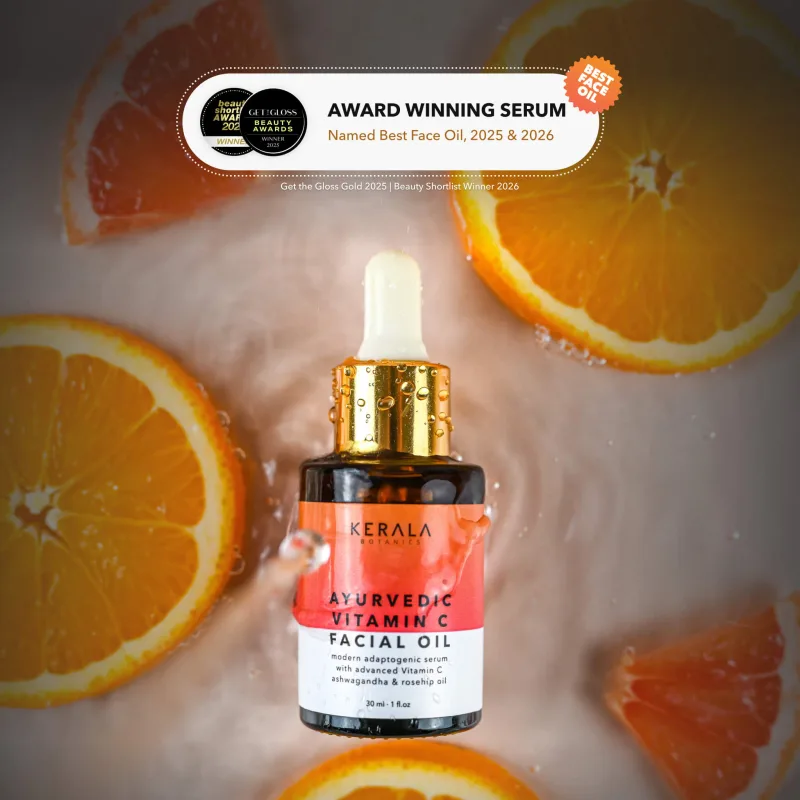
Ayurvedic Vitamin C Face Oil
Kerala Botanics
$49
★★★★☆
Pros: One step does the work of three. Oil format is unusual for vitamin C and gentler for many dry or mature skin types. Includes bakuchiol, which is useful if retinol is off the table. Priced well for what it replaces.
Cons: Oily and acne-prone skin may find it too rich. Less clinical data than C E Ferulic. Can feel heavy under makeup. Patch test first, as with any botanical-heavy oil (here’s how to patch test).
Verdict: A reasonable pick for dry skin and minimal routines. It’s not the evidence-first choice, and it doesn’t claim to be.
Neither of these contains CoQ10. That’s the point. If you want an antioxidant that has been studied in people, these formats have more to show for themselves.
How to use CoQ10 if you’re going to
If you do try a CoQ10 product, a few simple habits keep expectations realistic.
- Treat it as a supporting ingredient. Evaluate the moisturizer as a moisturizer first.
- Give it 8 to 12 weeks. The studies that saw anything ran at least that long. Anything promising overnight results is overstating.
- Look at the eye area. That’s where most of the small positive data sits, so that’s where you’d notice a change.
- Keep it away from heat and light. Store it cool and closed. Oxidized CoQ10 is a weaker antioxidant. Our notes on storing skincare properly apply here.
- Don’t stack expensive versions. If a $90 CoQ10 serum and a $15 cream both list it, you’re paying for packaging and story.
Putting it all together
CoQ10 is a real molecule with real roles in skin biology. Whether it does much when applied to the surface is a different question, and the answer so far is “a little, maybe.” The molecule is large, penetration is limited, and the mitochondrial claims run well ahead of anything measured. Ubiquinol sounds better than ubiquinone, but only if it survives the bottle.
The honest ranking: sunscreen first, a retinoid or retinol alternative second, a well-studied antioxidant like vitamin C third. CoQ10 sits somewhere behind those, a pleasant extra and not a foundation.
If it’s already in a cream you like, keep using it. If you’re deciding where to spend $50 or more, spend it elsewhere.