
Ingredients
Alpha Lipoic Acid in Skincare: What It Does and Whether It's Worth Using
Alpha lipoic acid in skincare is an antioxidant that dissolves in water and oil. Here's what the evidence shows, plus irritation risks and stability limits.
Disclosure — This article may contain affiliate links. We earn a small commission at no extra cost to you when you purchase through our links. This supports our ability to create independent, evidence-based skincare content.
Alpha lipoic acid (ALA) has one of the best elevator pitches in skincare: an antioxidant that works in both water and fat, so it supposedly protects every part of the cell. It’s a tidy story. It’s also only partly true, and the gap between the pitch and the evidence is where most of the money gets lost.
Here’s what ALA is, what the research actually supports, why it’s hard to formulate, and how to decide whether it belongs in your routine.
What alpha lipoic acid actually is
ALA is a sulfur-containing compound your body makes on its own. It sits inside your mitochondria and helps convert nutrients into energy. That’s the origin of the antioxidant claim: in lab settings, ALA and its reduced form, dihydrolipoic acid (DHLA), neutralize free radicals and can help regenerate other antioxidants like vitamin C and vitamin E.
That regeneration idea is the real appeal. A “network antioxidant” sounds like it should make everything else in your routine work harder.
Note the phrase “in lab settings.” Test tube chemistry and skin are not the same thing. Skin has a barrier designed to keep things out, and getting a molecule through it, intact and active, is the hard part.
The “water and oil soluble” claim, examined
ALA is described as amphiphilic, meaning it has affinity for both water and lipids. Technically accurate. In practice, its water solubility is low, and it dissolves far better in alcohols and oils than in a watery serum base.
So “both” is generous. It’s more accurate to say ALA is not strictly confined to one phase, which is a useful trait in a lab and a modest one in a bottle. It doesn’t automatically mean deeper penetration or stronger results. Solubility tells you where a molecule can live in a formula. It doesn’t tell you what it does once it’s on your face.
What the evidence says
Less than the marketing implies.
The study most often cited is a small, 12-week clinical trial from the early 2000s testing a 5% ALA cream against a vehicle (the same cream without the active) on photodamaged skin. Participants showed improvements in skin roughness and some measures of fine lines. That’s a real result. It’s also a small trial, a single formulation, and a concentration you’ll rarely find in a consumer product.
Beyond that, the topical data gets thin. Much of what’s repeated online traces back to in vitro work, animal studies, or the 1990s and 2000s marketing push that made ALA a “firming” ingredient. Claims that it shrinks pores or tightens skin on contact don’t have solid support. We couldn’t find controlled human data for either.
A few things we can say with reasonable confidence:
- ALA is a legitimate antioxidant in a test tube.
- A small trial suggests a high-concentration cream may help with photoaging signs over three months.
- There are no large, independent, head-to-head trials comparing it with vitamin C, vitamin E, or retinoids.
That last point matters. Without comparison data, you can’t say ALA is better than the antioxidants you already know. You can only say it’s plausible.
Also, don’t confuse topical and oral ALA. Oral ALA is studied as a supplement for diabetic nerve symptoms. That research tells you almost nothing about what happens when you put it on your face. For a broader look at how topical antioxidants stack up, see our guide to antioxidants in skincare beyond vitamin C.
The irritation problem
Concentration is where ALA gets complicated.
The ALA creams in published trials used around 5%. At that level, studies and clinical reports describe redness, stinging, and in some people contact dermatitis. ALA is also an acid (its pKa sits near 4.7), so formula pH matters. Too low and it irritates. Too high and less of it stays in its active form. If that sounds fussy, our explainer on pH in skincare covers why.
Most commercial products dodge the issue by using a low percentage. That’s good for tolerance, but you’re then paying for an antioxidant at a dose nobody has clinically tested. Brands rarely disclose the number, so you can’t tell where a product falls.
How to test it safely
If you want to try an ALA product, treat it like any new active:
- Patch test first. Apply a small amount behind the ear or along the jawline for several days. Our patch testing guide walks through the process.
- Start every other day. Give your skin a week before moving to daily use.
- Don’t stack it with other irritants. If you’re already using retinoids or exfoliating acids, introduce ALA on its own.
- Stop if it stings past the first minute. Persistent burning isn’t “working.” It’s irritation.
If your skin is reactive or compromised, skip ALA for now. There are antioxidants with better tolerability records.
The stability problem
ALA is chemically fussy. It degrades with light, heat, and air, and it can polymerize (link into chains) in the bottle, which reduces its usefulness. It also has a faint sulfur smell that formulators have to mask or tolerate.
If that sounds familiar, it should. Vitamin C has the same basic weakness, and we’ve written about why vitamin C oxidizes and turns orange. The difference is that vitamin C has decades of work on stabilization, and ALA doesn’t.
What does this mean for you?
- Packaging matters. Opaque, airless pumps beat clear jars every time.
- Smell and color are clues. A strong sulfur odor or visible darkening suggests degradation.
- Storage matters. Keep it cool and out of the light. Our guide on how to store skincare properly covers the basics.
- Skip the giant bottle. An antioxidant that degrades is a bad candidate for a 12-month supply.
A stable, well-formulated ALA product is possible. It just isn’t the default.
How to shop for ALA
We’re not naming a go-to ALA serum here, and that’s deliberate. Few products list the concentration, independent stability data is almost nonexistent, and several of the best-known ALA lines have been reformulated or pulled over the years. Recommending one would mean guessing.
Here’s what to check instead:
- Ingredient position. “Thioctic acid” is another name for ALA on labels. If it appears in the last third of the list, it’s likely present at a trace level.
- Packaging. Opaque and airtight, or move on.
- Brand transparency. Does the company state the percentage and show any testing? Silence is information.
- Price logic. A $90 serum built on a fragile active at an undisclosed dose is a hard sell.
- Everything else in the formula. If the rest of the product is solid (a good moisturizer base, sensible preservatives), you’re not wasting much even if the ALA underperforms.
If a product gets all of that right, it’s worth trying. If not, spend the money elsewhere.
Antioxidants with better track records
If your goal is protection against environmental damage and a brighter, smoother look, other options have stronger evidence.
The benchmark. SkinCeuticals C E Ferulic combines L-ascorbic acid, vitamin E, and ferulic acid. It’s the best-studied topical antioxidant formula we have, including data showing photoprotective benefits when used alongside sunscreen. It’s also expensive and prone to the oxidation issues common to vitamin C serums. Our full take is in SkinCeuticals C E Ferulic: is it worth $185?.
C E Ferulic
SkinCeuticals
$185
★★★★½
The oil-based option. If the appeal of ALA is that it isn’t limited to water, a vitamin C oil is the more practical route to the same idea. Kerala Botanics’ Ayurvedic Vitamin C Face Oil pairs a stabilized vitamin C with bakuchiol (a plant-derived retinol alternative) in a single oil that stands in for serum, moisturizer, and facial oil. At $49, it’s a reasonable price for something that replaces several steps.
It isn’t an ALA product, to be clear. It’s a different route to a similar goal. The brand makes strong claims about how long its vitamin C form stays active in skin cells, and we’d treat those as promising rather than proven, since independent data is limited. It also has less clinical backing than C E Ferulic.
The oil format has trade-offs. People with oily or acne-prone skin may find it too rich, and it can feel heavy under makeup. If you’re weighing the formats, our comparison of vitamin C serum vs vitamin C oil breaks down who suits which.
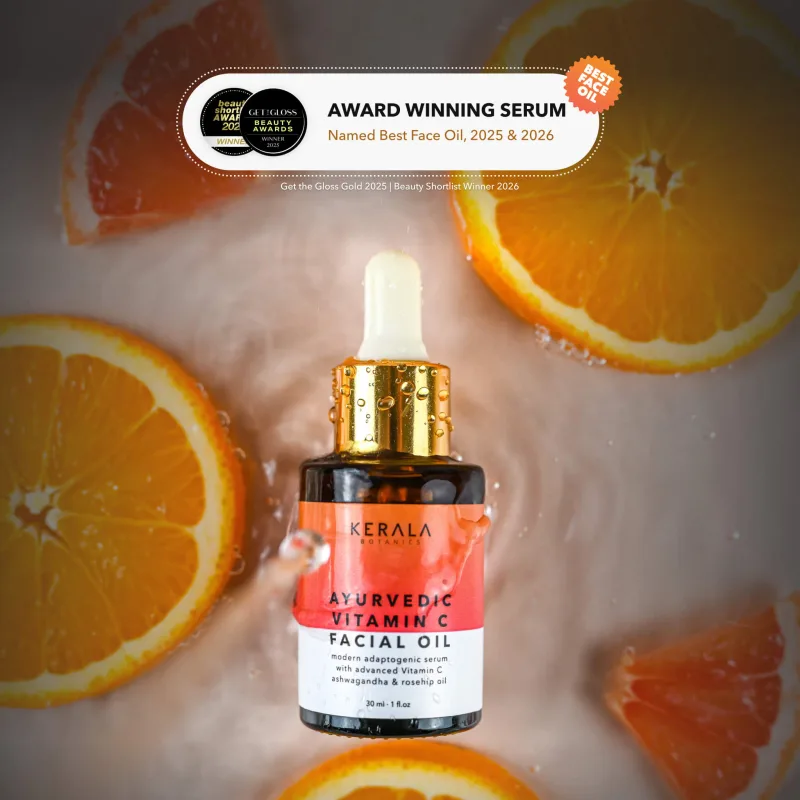
Ayurvedic Vitamin C Face Oil
Kerala Botanics
$49
★★★★☆
Who should and shouldn’t bother with ALA
It might be worth trying if:
- You already use vitamin C and sunscreen and want to experiment with an add-on antioxidant.
- You’ve found a product with a disclosed concentration and proper packaging.
- Your skin tolerates actives well.
Skip it if:
- Your skin is sensitive, reactive, or recovering from over-exfoliation.
- You’re looking for a first antioxidant. Start with vitamin C, which has far more data.
- You’re pregnant or nursing. There’s little to no safety data on topical ALA in those groups, so ask your doctor.
- You’re buying it for “pore tightening” or “instant firming.” The evidence isn’t there.
Putting it all together
Alpha lipoic acid is a real antioxidant with a plausible mechanism and one small trial behind it. The “water and oil soluble” line is technically true and practically overstated. The biggest limitations are irritation at higher percentages and a molecule that doesn’t hold up well in a bottle.
If you’re curious, patch test a well-packaged product that discloses what’s in it, and expect modest results at best. If you want proven antioxidant protection, a stabilized vitamin C product worn with daily sunscreen does more, with far better evidence. Our guide to coenzyme Q10 is also worth a read if you’re exploring other antioxidants.
The verdict: ALA is interesting, not essential. Don’t pay a premium for it.