
Ingredients
Thiamidol vs Hydroquinone: The Pigment Question
Thiamidol vs hydroquinone for dark spots and melasma: how each works, what the evidence shows, where to buy, and realistic timelines for visible results.
Disclosure — This article may contain affiliate links. We earn a small commission at no extra cost to you when you purchase through our links. This supports our ability to create independent, evidence-based skincare content.
Two ingredients matter in this conversation. Hydroquinone is the old standard, and thiamidol is the newer, shelf-friendly challenger. Both slow the enzyme that makes pigment. They differ in strength, safety profile, and how easy they are to get.
The short version: thiamidol is the better first move for most people, mainly because you can actually buy it and use it for a long time. Hydroquinone is still the stronger tool for stubborn pigment, but it comes with rules.
How Dark Spots Form (and Where These Ingredients Step In)
Pigment starts with tyrosinase. It’s the enzyme inside pigment cells that turns the amino acid tyrosine into melanin. Sun, inflammation, and hormones all push that machine harder.
Both ingredients here are tyrosinase inhibitors. They don’t remove existing pigment. They slow new production, and the spots fade as skin turns over. That’s why everything takes weeks, not days.
If you’re not sure what kind of mark you have, start with our hyperpigmentation treatment guide. Red marks and brown marks need different handling, and PIE vs PIH covers that split.
What Thiamidol Is
Thiamidol is the trade name for isobutylamido thiazolyl resorcinol. You’ll see that mouthful on the ingredient list. Beiersdorf, the parent company of Eucerin, found it by screening tens of thousands of compounds against human tyrosinase, not the mushroom tyrosinase most older studies relied on.
That detail matters. Many ingredients that look strong against mushroom enzyme are mediocre on human skin. Hydroquinone is one of them. In the lab work behind thiamidol, it inhibited human tyrosinase at far lower concentrations than hydroquinone, arbutin, or kojic acid.
Clinical results back this up, with a caveat. In head-to-head studies in melasma and age spots, 0.2% thiamidol performed as well as or better than 2% hydroquinone, with fewer side effects. Most of this research was funded by the company that owns the patent. The data is good. It’s just not independent, and we’d like to see more trials from outside groups.
Why You Only See It in Certain Products
Patent protection restricts thiamidol to Beiersdorf’s own brands. In practice that means Eucerin, and in some markets its sister brand Nivea. You won’t find it in a Paula’s Choice serum or a The Ordinary bottle.
Availability also varies by region. Eucerin’s Anti-Pigment line is widely sold in Europe and the UK, and a smaller range has reached the US. Product names differ from country to country, so check the ingredient list for isobutylamido thiazolyl resorcinol instead of trusting the front label.
Eucerin Radiant Tone Brightening Spot Corrector (Thiamidol)
Eucerin
$30
★★★★½
Pros: strong human-enzyme data, gentle on most skin, fragrance-light formulas, no cycling on and off. Cons: limited to one company’s products, a narrow range of textures, and results that arrive slowly. If the thiamidol product in your region is a day cream with SPF, that’s convenient, but don’t count it as your full sun protection.
What Hydroquinone Is
Hydroquinone has been used for decades. It’s a tyrosinase inhibitor that also reduces pigment cell activity, and dermatologists still reach for it first when pigment is stubborn or dense.
It works. That’s never been the debate. The debate is safety over time.
The Risks Worth Knowing
Hydroquinone can cause irritation, redness, and contact dermatitis. With prolonged use at higher strengths, it can rarely cause exogenous ochronosis, a blue-gray darkening that’s hard to treat. Risk is higher with unsupervised long-term use, and it’s reported more often in deeper skin tones. The same skin tones are often the ones most affected by stubborn pigment, which makes this a real bind.
That’s why hydroquinone is typically used in courses. Think three to four months, then a break, guided by a clinician.
Where You Can Actually Get It
This varies a lot by country.
- United States: It’s now effectively prescription territory. OTC 2% products lingered after rule changes in 2020, but the legal status has been unsettled. A prescription gets you 4% or a compounded blend, usually with tretinoin and a steroid.
- EU and UK: Banned in cosmetics. You won’t find it over the counter.
- Elsewhere: Rules differ, and unregulated skin-lightening products are a real problem. Some contain mercury or hidden steroids. Skip anything that looks unlabeled or unusually strong.
This is a big part of why thiamidol exists as a product category. For a lot of people, hydroquinone isn’t a realistic option without a prescription.
Thiamidol vs Hydroquinone: Side by Side
| Thiamidol | Hydroquinone | |
|---|---|---|
| Typical strength | 0.2% | 2% OTC (where sold), 4% Rx |
| Evidence | Strong, mostly manufacturer-funded | Decades of use, independent data |
| Speed | Visible change around 8 to 12 weeks | Often 4 to 8 weeks |
| Irritation | Low in trials | Moderate, more common |
| Long-term use | Designed for continuous use | Short courses with breaks |
| Availability | Eucerin (and some Nivea) only | Rx in the US, banned in cosmetics in EU/UK |
| Best for | Mild to moderate spots, melasma maintenance | Stubborn or dense pigment under supervision |
The honest read: hydroquinone has a higher ceiling and a lower floor. Thiamidol has a lower ceiling and a much higher floor. Most people live closer to the floor than the ceiling.
Which One Fits Which Kind of Pigment
Pick by pigment type, not by hype.
Post-acne marks and sun spots. Thiamidol is a solid first choice. These respond to consistent, gentle inhibition plus sun protection. Hydroquinone is overkill unless the marks have lingered for years.
Melasma. This one is hormonal, vascular, and prone to relapse. Thiamidol shows real promise, particularly for maintenance. Many dermatologists still use hydroquinone for the initial push, often with tranexamic acid or in-office procedures. Our melasma treatment guide and the piece on tranexamic acid cover the full toolkit.
Deeper skin tones. Start gentle. Irritation causes more pigment, and aggressive treatment can backfire. Thiamidol’s low irritation profile is an advantage here. Anyone with melasma or PIH in deeper skin should see a dermatologist before trying hydroquinone.
Pregnancy. Neither is a clear green light. Hydroquinone absorbs more than most topicals and is generally avoided. For options, see pregnancy-safe brightening.
Realistic Timelines
This is where most people quit too early.
- Weeks 1 to 4: Nothing visible, usually. The skin is adjusting.
- Weeks 4 to 8: With hydroquinone, early lightening shows up. With thiamidol, spots may look slightly softer.
- Weeks 8 to 12: Thiamidol’s real results appear. Trial data mostly reads out at 12 weeks.
- Months 3 to 6: Where meaningful improvement shows for deeper or older marks, with either ingredient.
If twelve weeks pass with consistent use and sunscreen and nothing has changed, it’s time to see a dermatologist. Don’t switch products every three weeks. We cover this rhythm in how long skincare takes to work.
The Part That Matters More Than the Ingredient
Sunscreen. Daily. Every morning, enough of it.
Without it, neither ingredient will hold. Ten minutes of strong sun can restart what eight weeks of treatment calmed down. For melasma, visible light matters too, which means tinted or iron-oxide sunscreens help more than clear ones.
Three habits cover most of it:
- Apply sunscreen every morning, even on cloudy days
- Hands off the spots. Picking creates inflammation, and inflammation creates pigment
- Introduce one active at a time, so irritation has an obvious cause
The Supporting Cast
Neither ingredient needs a crowd around it. If you want one addition, vitamin C is a sensible, gentle one. It’s an antioxidant that also nudges pigment production down, and it plays well alongside a tyrosinase inhibitor in the morning.
Most vitamin C comes as a water-based serum. A few come as oils, which is a useful distinction if you dislike the sting of an acidic serum. We broke down the difference in vitamin C serum vs oil.
Kerala Botanics’ Ayurvedic Vitamin C Face Oil is one example of the oil route. It pairs a stabilized vitamin C with bakuchiol, and it replaces a serum, moisturizer, and oil in one step, which suits people trimming a routine.
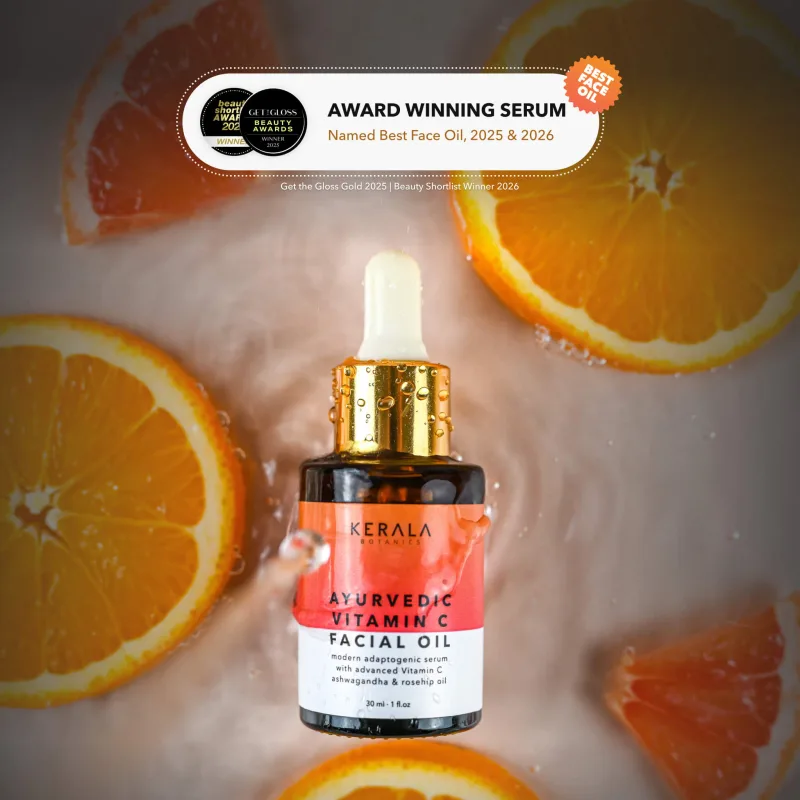
Ayurvedic Vitamin C Face Oil
Kerala Botanics
$49
★★★★☆
Pros: gentle, one-step, no tingling. Cons: it isn’t a pigment treatment on the level of thiamidol or hydroquinone, so think of it as upkeep and glow, not a spot fixer. Oily or acne-prone skin may find the oil format heavy, it can sit thick under makeup, and it has less clinical data behind it than the big-name vitamin C serums.
For other gentler brighteners, alpha arbutin and kojic acid are the usual alternatives. They’re weaker than thiamidol, but easier to find across brands.
Can You Combine Thiamidol and Hydroquinone?
Not usually, and there’s no reason to. They target the same enzyme. Stacking them adds irritation without adding much more benefit.
A more sensible pattern, if a dermatologist agrees: use hydroquinone for a defined course, then move to thiamidol for maintenance. That takes advantage of hydroquinone’s strength and thiamidol’s tolerability. It also avoids the open-ended hydroquinone use that causes the problems.
Who Should Skip Both
If your marks are flat and red or pink, they’re PIE, not pigment, and tyrosinase inhibitors won’t touch them. If you’ve had a mole change shape or color, that isn’t a cosmetic question. And if your skin is currently irritated or barrier-damaged, repair it first, because inflamed skin makes more pigment.
Putting It All Together
Thiamidol is the practical choice. It’s gentle, studied in human enzyme models, and built for continuous use. Its limits are the single-company supply and the manufacturer-funded research.
Hydroquinone is the stronger option and still worth discussing with a dermatologist for stubborn cases, ideally in a short course with a plan for what comes after.
Whichever you pick, give it twelve weeks, wear sunscreen daily, and leave the spots alone. The ingredient is maybe half of the result. The rest is patience, and that’s the one thing no product label can supply.