
Ingredients
Ascorbyl Tetraisopalmitate: The Oil-Soluble Vitamin C
Ascorbyl tetraisopalmitate is the oil-soluble vitamin C derivative behind newer face oils. Here's what conversion, penetration, and stability data actually show.
Disclosure — This article may contain affiliate links. We earn a small commission at no extra cost to you when you purchase through our links. This supports our ability to create independent, evidence-based skincare content.
Ascorbyl tetraisopalmitate sounds like a compound someone made up to fill space on an ingredient list. It isn’t. It’s a real, patented form of vitamin C, and it’s the reason a growing number of “vitamin C oils” exist at all — because L-ascorbic acid, the gold-standard form everyone knows, doesn’t dissolve in oil. It needs water. So if a brand wants vitamin C in an anhydrous, oil-based format, they need a different molecule entirely.
That molecule is usually ascorbyl tetraisopalmitate, or ATIP. It shows up in Kerala Botanics’ Ayurvedic Vitamin C Face Oil, in some Japanese and French formulations going back decades, and increasingly in newer indie brands chasing the “oil that does everything” trend. The marketing around it tends to overpromise. The actual research tells a more specific, more interesting story — and a more limited one.
What Ascorbyl Tetraisopalmitate Actually Is
ATIP is L-ascorbic acid with four palmitic acid chains attached. Those fatty acid tails are what make the difference. Plain vitamin C is hydrophilic — it loves water, hates oil, and oxidizes fast once it’s exposed to air or light. Bolt four lipid chains onto it and you get a fat-soluble molecule that sits comfortably in an oil base, slides through the lipid layers of the skin barrier more easily, and resists oxidation far longer than its parent compound.
This isn’t a new idea. Chemists have been attaching fatty acid chains to vitamin C since the 1990s specifically to solve the stability and penetration problems that plague L-ascorbic acid serums. Ascorbyl palmitate (one chain) came first. ATIP (four chains) came later and penetrates further, according to the formulation research that exists — which, we’ll get to, isn’t a huge body of work.
If you want the fuller comparison between this derivative and the traditional water-based approach, we broke it down in oil-soluble vs. water-soluble vitamin C. This article is about ATIP specifically: what it does once it’s on your skin, and where the evidence runs out.
The Conversion Problem: Does It Actually Become Vitamin C?
Here’s the part that matters most and gets glossed over the most.
ATIP is a prodrug. It has to be converted back into active ascorbic acid inside the skin before it can do anything vitamin C actually does — support collagen synthesis, act as an antioxidant, interfere with melanin production. The fatty acid chains that make it stable and penetrative also make it inert until enzymes in the skin (esterases) cleave them off.
The conversion does happen. In vitro studies using skin cell cultures show ATIP gets metabolized into ascorbic acid, and cells treated with it show increased collagen synthesis and reduced UV-induced damage, comparable in some assays to direct ascorbic acid treatment. That’s real and worth something.
What’s murkier is the rate and completeness of that conversion in actual human skin, in actual use conditions, over an actual 8-to-12-week window. Esterase activity varies by skin type, by depth of penetration, by how much of the applied dose even makes it past the stratum corneum before conversion starts. Nobody has published a clean human trial tracking exactly what percentage of a topically applied ATIP dose ends up as free ascorbic acid in the dermis versus the epidermis versus just sitting unconverted on the surface.
So the honest answer is: yes, it converts, and the conversion produces biologically active vitamin C. But we don’t have the granular human data to say it converts as efficiently, or delivers as much active ascorbic acid, as a well-formulated 15% L-ascorbic acid serum. Anyone claiming otherwise is reading more into the in vitro data than it supports.
Penetration: The One Thing ATIP Does Better
This is where ATIP earns its keep.
L-ascorbic acid is a small, charged molecule that’s great at staying in water and bad at crossing the lipid-rich stratum corneum. That’s part of why traditional vitamin C formulas need a low pH (around 3.5) just to get any meaningful amount through the skin at all — the acidic environment neutralizes the molecule’s charge long enough for it to slip through.
ATIP doesn’t have that problem. Its lipid tails let it partition directly into the skin’s own lipid matrix, the same route facial oils use to deliver anything fat-soluble. Penetration studies on lipid-conjugated vitamin C derivatives — including ATIP specifically — have found meaningfully deeper skin penetration than free ascorbic acid, and some research suggests these esterified forms persist in skin tissue considerably longer after application, since they’re not immediately washed out or oxidized the way free ascorbic acid is.
This tracks with the manufacturer claims you’ll see attached to “advanced vitamin C” formulations, including Kerala Botanics’ — the assertion that it stays active in skin cells far longer than a standard serum. The mechanism behind that claim is real (lipid solubility does extend residence time). What’s less independently verified is the specific multiplier claimed, since that figure traces back to manufacturer-funded testing rather than an independent, peer-reviewed head-to-head. Real mechanism, marketing-flavored number. Hold both of those thoughts at once.
Stability: Why It Doesn’t Turn Orange
If you’ve ever watched a bottle of vitamin C serum drift from clear to amber over a few weeks, you’ve watched oxidation happen in real time. We wrote a full explainer on why vitamin C oxidizes orange if you want the chemistry, but the short version: L-ascorbic acid reacts with oxygen and light, and once it starts degrading, it doesn’t just go inert — it can form byproducts that are mildly irritating and definitely useless as antioxidants.
ATIP’s oil solubility changes this equation. Anhydrous formulas — no water, which means no hydrolysis pathway to kick things off — are inherently more stable than water-based ones. Combine that with the fact that the fatty acid chains themselves shield the ascorbic acid core from oxidative attack, and you get a derivative that holds up in a bottle far longer than free L-ascorbic acid does.
This is a genuine advantage, not a marketing footnote. If shelf stability is your priority — say, you’re bad about finishing serums before the three-month mark, or you’re buying in bulk — an ATIP-based oil is a more forgiving purchase than most vitamin C serums. It’s part of why the format has staying power beyond the trend cycle. For a deeper look at how facial oils behave over time, when to throw out skincare covers the general oxidation timeline across formats.
The Honest Limits — Clinical Evidence Is Thin
Now the part the marketing copy skips.
L-ascorbic acid has decades of human clinical trials behind it — randomized, controlled, published in actual dermatology journals, measuring things like collagen density, photoaging scores, and pigmentation over defined timeframes. SkinCeuticals built an entire premium brand on citing that literature, and we’ve covered whether CE Ferulic is worth $185 largely on the strength of that evidence base.
ATIP does not have that. What exists is mostly in vitro (cell culture) and animal-model research, plus a handful of smaller human studies, several of which were funded by ingredient suppliers rather than independent academic groups. That doesn’t make the findings wrong. It makes them preliminary. There’s a real difference between “this molecule demonstrably converts to active vitamin C and shows antioxidant activity in lab conditions” and “this molecule has been shown, in a double-blind randomized trial, to reduce photoaging in human subjects over 12 weeks.” ATIP has plenty of the first kind of evidence and almost none of the second.
If you’re choosing vitamin C purely on the strength of clinical proof, L-ascorbic acid still wins, and it’s not close. If you’re choosing based on formulation logic — stability, penetration mechanism, and a defensible (if not exhaustively proven) path to active vitamin C in skin — ATIP is a reasonable, evidence-informed bet. Just don’t let anyone tell you it’s clinically interchangeable with the serum your dermatologist recommends. It isn’t, at least not yet.
Worked Example: Kerala Botanics Ayurvedic Vitamin C Face Oil
Kerala Botanics’ face oil is a useful case study because it doesn’t try to be just a vitamin C delivery vehicle. It pairs ATIP with bakuchiol, the plant-based retinol alternative we’ve covered at length in bakuchiol vs. retinol, and builds the whole thing on a carrier oil base meant to replace serum, moisturizer, and facial oil in one step.
The formulation logic holds up. ATIP gives you an oil-compatible vitamin C that won’t oxidize on your bathroom shelf the way a cracked-open L-ascorbic acid serum would. Bakuchiol adds a retinoid-adjacent mechanism without the irritation or sun sensitivity tretinoin carries. And the oil base itself does the job an occlusive moisturizer would, for people who want fewer steps rather than more.
Where it falls short of a clinical powerhouse like CE Ferulic: less independent human trial data specifically on this formula, an oil texture that oily or acne-prone skin may not love (worth reading linoleic vs. oleic fatty acid ratios if breakouts are a concern), and a brightening effect that’s more gradual and subtle than what you’d get from a well-preserved 15-20% L-ascorbic acid serum. It can also sit heavier under makeup than a lightweight serum-moisturizer combo, so it’s a better fit for evening routines or minimal-makeup days.
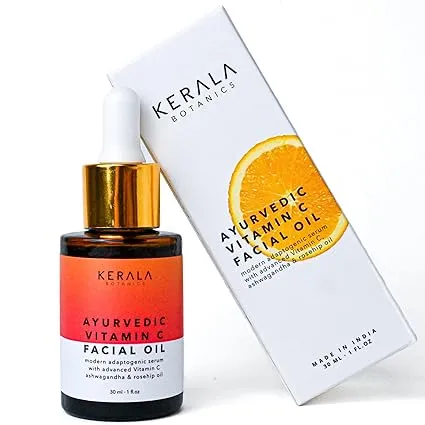
Ayurvedic Vitamin C Face Oil
Kerala Botanics
$49
★★★★☆
We reviewed it in full detail in the Kerala Botanics Vitamin C Face Oil review, including a week-by-week breakdown of texture and results. For a broader sense of how it stacks up against other oil-format options, best vitamin C face oils of 2026 is worth a look too.
Who Should Use ATIP (and Who Shouldn’t)
ATIP-based products make the most sense for a few specific readers. If you have dry or normal skin and want to simplify a routine down to fewer steps, an oil that combines vitamin C and moisturizer solves a real problem. If you’ve had reactions to low-pH L-ascorbic acid serums — the vitamin C burn is a real thing for reactive skin — ATIP’s near-neutral pH tolerance is genuinely gentler. And if you’re drawn to Ayurvedic or natural-format skincare, this is one of the few evidence-backed entries in that space; our Ayurvedic vitamin C guide covers the traditional side of that comparison.
It’s a worse fit if you’re oily or acne-prone and already cautious about adding oils to your routine, or if you specifically want the strongest, most clinically documented vitamin C available and don’t mind the higher maintenance that L-ascorbic acid demands. In that case, a serum like CE Ferulic — or one of the affordable vitamin C dupes we’ve tested — is still the better-supported choice.
Putting It All Together
Ascorbyl tetraisopalmitate solves two real problems with traditional vitamin C: it doesn’t dissolve in oil, and it oxidizes fast. ATIP fixes both by attaching fatty acid chains to the ascorbic acid molecule, trading some conversion efficiency for better stability and deeper penetration through the skin’s lipid layers.
The conversion to active vitamin C is real but not fully mapped in human skin. The penetration advantage is well-supported by the mechanism, even if some of the specific numbers you’ll see in marketing come from manufacturer testing rather than independent trials. And the clinical evidence, compared to decades of L-ascorbic acid research, is thin — promising, but early.
If that trade-off — better shelf life and gentler application in exchange for less proven potency — works for your skin and your routine, ATIP is worth trying. If you want maximum, clinically documented brightening power and don’t mind babysitting a serum’s expiration date, stick with the original.