
Ingredients
Urea: The Boring Derm Staple Having a 2026 Moment
Urea is the derm-trusted humectant and keratolytic your routine is probably missing. Here's what it does, who needs it, and how to use it.
Disclosure — This article may contain affiliate links. We earn a small commission at no extra cost to you when you purchase through our links. This supports our ability to create independent, evidence-based skincare content.
Nobody is going to make a 30-second reel about urea. There’s no satisfying drop, no color change, no foam cloud. It’s a small, water-soluble molecule that’s been in prescription creams since the 1940s and drugstore lotions since before most of us were born. Dermatologists have recommended it for decades. Eczema patients know it. Podiatrists swear by it.
And yet, if you asked ten skincare enthusiasts to name their top five ingredients, urea wouldn’t make the list.
That’s changing. As eczema rates climb, as the barrier-first movement matures past ceramides and slugging, and as more people get burned out from over-exfoliation and want something that actually heals rather than strips — urea keeps showing up. Quietly, without fanfare, in the way that effective things tend to.
This guide explains exactly what urea does, how it does it, who benefits most, and how to work it into a routine without overcomplicating things.
What Urea Actually Is
Urea is a naturally occurring compound produced by the body as a byproduct of protein metabolism. It’s found in healthy skin as part of the natural moisturizing factor (NMF) — the collection of water-binding molecules that keep the stratum corneum hydrated and functional. When NMF is depleted (by harsh cleansers, low humidity, age, or conditions like eczema and psoriasis), the skin loses its ability to hold water efficiently. The surface gets rough. It cracks. Products don’t absorb well.
Topical urea replenishes what’s missing. But it doesn’t do just one thing, which is what makes it unusual.
At lower concentrations (2–10%), urea works primarily as a humectant: it pulls water into the skin and binds it there. At higher concentrations (20–40%), it becomes keratolytic — meaning it breaks down the protein bonds in thickened, dead skin, softening and loosening buildup without any physical friction required. Some products sit in the middle range (10–20%) and do a bit of both.
That dual action — hydrate and exfoliate, depending on the dose — is the reason dermatologists keep reaching for it. Most ingredients do one or the other.
Why It Works: The Mechanism
The keratolytic effect comes from urea’s ability to disrupt hydrogen bonding between keratin proteins in the stratum corneum. Keratin is what skin cells are primarily made of. When those cells accumulate abnormally (as in keratosis pilaris, eczema plaques, or just very dry, thickened heel skin), the bonds between them hold tight. Urea loosens them.
It also increases skin permeability, which sounds like a downside but is actually why it’s often formulated alongside other actives — urea helps them penetrate better. Some studies have examined urea as a penetration enhancer for hydrocortisone in eczema formulations, and the evidence is reasonably solid that it helps.
As a humectant, urea has a distinct advantage over hyaluronic acid in one specific condition: low humidity. Hyaluronic acid draws moisture from both the environment and deeper skin layers. In dry climates or dry indoor air, it can theoretically pull moisture out of the skin if there’s nothing sealing it in. Urea binds more tenaciously to existing water in the NMF, making it more reliable in arid conditions.
Who Actually Needs Urea
Most people. But especially:
People with eczema or psoriasis. Urea is one of the few OTC ingredients with consistent clinical backing for atopic dermatitis. A 2019 study in Acta Dermato-Venereologica found that 5% urea cream used as maintenance therapy significantly reduced flare frequency compared to standard emollients alone. It doesn’t replace prescription treatments during active flares, but as a daily maintenance tool it’s legitimate.
Anyone dealing with keratosis pilaris. KP — those rough, bumpy patches on the upper arms and thighs — responds well to urea at 10–20%. It’s one of the better-evidenced OTC options for the condition, alongside lactic acid and salicylic acid. Our keratosis pilaris treatment guide covers this in more detail, but urea is on the short list of ingredients that actually move the needle.
People with very dry or cracked heels. This is where high-concentration urea (25–40%) earns its reputation. Callused heel skin is thick, dehydrated, and doesn’t respond to regular lotion the way normal skin does. High-dose urea softens it within days.
Anyone with a compromised barrier. If your skin is reactive, flaky, and slow to recover — whether from over-exfoliation, climate, or just genetic tendency toward dryness — lower-concentration urea is a useful addition to a repair routine. It supports the NMF without the irritation risk of AHAs or retinol.
Concentration Guide: Which Percentage to Use Where
This is the part most articles skip over, and it’s the most practical thing to understand about urea.
2–5%: Daily Hydration, Sensitive Skin
Good for faces and general moisturization. Non-irritating for most skin types, including those with eczema. At this level, urea is basically functioning as a high-performance humectant. Look for it in lotions and creams designed for sensitive or atopic skin.
10%: Light Exfoliation, Body Hydration
The general-purpose sweet spot for body care. Softens rough patches without being aggressive. Appropriate for legs, arms, elbows. Fine for regular use.
20–30%: Moderate Keratolysis
For KP, thickened skin patches, and dry scalp conditions. Use targeted — not all over. Some people use 20% urea cream on their elbows or feet nightly until the skin normalizes, then drop to maintenance.
40% and above: Calluses and Severe Cracking
This is prescription territory in many countries, but some OTC heel products in the 25–40% range exist. Do not put this on your face. Do not use it on inflamed or broken skin. This concentration will cause stinging on damaged tissue.
How to Layer Urea in a Routine
Urea plays well with almost everything. A few notes:
It works well after water-based serums, applied while skin is still slightly damp to maximize its water-binding effect. If you’re using it on your body, apply within a few minutes of showering.
It’s compatible with ceramides, niacinamide, peptides, and most barrier-focused ingredients. Pairing it with ceramides makes particular sense: urea draws and holds water in the NMF, while ceramides reinforce the lipid matrix that prevents that water from evaporating. They work through different mechanisms and complement each other. Our ceramides guide is worth reading alongside this one.
At higher concentrations, urea increases skin permeability — so be thoughtful about what you apply directly after a 20%+ product. Pairing it with a potentially irritating active (a high-strength retinol, for example) on the same skin area at the same time might cause more sensitivity than either would cause alone.
For the face, 2–5% urea in a moisturizer is the cleanest approach. You probably don’t need to layer it on top of multiple other actives. Use it as your moisturizer, not as an additional step.
The Best Urea Products Worth Buying
Here’s where the “boring derm staple” label actually works in your favor: urea is inexpensive, well-understood, and formulated into some of the most reliably effective drugstore products on the market.
For the Face and Sensitive Body Skin: Eucerin UreaRepair Plus 5% Urea Lotion
Eucerin’s UreaRepair line has more clinical data behind it than most skincare brands will ever accumulate. The 5% urea formula is light enough for daily use, pairs the urea with ceramides and natural moisturizing factor components, and works consistently for atopic skin. Not exciting. Works.
Eucerin UreaRepair Plus 5% Urea Lotion
Eucerin
$18
★★★★½
For Body Care and KP: CeraVe SA Smoothing Cream
CeraVe’s SA cream doesn’t lead with urea (the primary exfoliant is salicylic acid), but it’s formulated with both urea and lactic acid alongside its ceramide base. That combination — keratolytic exfoliants plus barrier lipids — is exactly what KP and rough body skin need. The texture is thick but absorbs without leaving residue.
CeraVe SA Smoothing Cream
CeraVe
$19
★★★★½
For Heels: Flexitol Heel Balm 25% Urea
Twenty-five percent urea in a dense balm format. For cracked, callused heel skin specifically, this is the straightforward answer. Apply overnight with socks. Results in a few days for most people. Cheap.
Flexitol Heel Balm 25% Urea
Flexitol
$9
★★★★½
What About Face Oils for Barrier Repair?
Urea is water-soluble, so it doesn’t appear in anhydrous (oil-only) formulas. But if your goal is barrier support and hydration, oil-based products can complement a urea routine rather than compete with it. An oil applied after a urea-containing moisturizer can act as an occlusive layer, reducing water loss and giving the urea more time to work.
The Kerala Botanics Ayurvedic Vitamin C Face Oil is worth mentioning here for a different reason: it contains bakuchiol alongside a stabilized vitamin C derivative, and it functions as a serum, moisturizer, and facial oil in one step. If your routine is already getting complex with targeted urea treatments, something that consolidates other steps has appeal. The oil format means it’s better suited for drier skin types — those prone to congestion may find it heavy. And it’s an interesting option for anyone exploring oil-based alternatives to traditional serums, as we covered in our Vitamin C Serum vs Vitamin C Oil comparison.
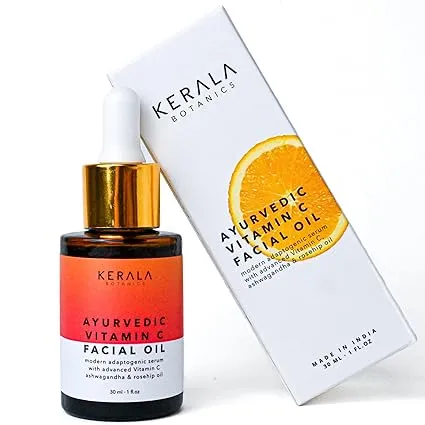
Ayurvedic Vitamin C Face Oil
Kerala Botanics
$49
★★★★☆
Common Questions, Answered Briefly
Can you use urea if you have oily or acne-prone skin? At 2–5%, yes — it’s not comedogenic and it doesn’t increase oil production. Higher concentrations on the face are less commonly needed for oily skin types, and the thickness of high-concentration creams may not suit them. On the body, concentration matters less for oiliness.
Does urea sting? At low concentrations on intact skin, no. On cracked, inflamed, or broken skin, higher concentrations absolutely will. If you’re using a 20%+ product and your skin is raw, give it time to heal first.
Can you use urea with retinol? Yes, but be thoughtful about timing and concentration. Low-concentration urea (5–10%) in a moisturizer is fine applied after retinol has fully absorbed. Applying high-concentration urea immediately before retinol on the same area may increase retinol penetration and, with it, irritation risk.
Is urea safe during pregnancy? Topical urea at low concentrations is generally considered safe, but as with anything during pregnancy, it’s worth checking with your provider. Our pregnancy-safe glow routine covers the broader category of what’s generally considered low-risk.
Putting It All Together
Urea isn’t having a moment because it suddenly started working. It’s having a moment because people are finally looking past the trend cycle and asking what the evidence actually supports.
The ingredient is a legitimate dual-action tool: humectant at low concentrations, keratolytic at high ones. It’s clinically documented for eczema maintenance, keratosis pilaris, and cracked heel repair. It works in dry climates where hyaluronic acid can underperform. It’s cheap, widely available, and has a safety record spanning decades.
If you have dry, rough, or reactive skin, and you haven’t tried urea yet, the question isn’t why you’d add it. The question is why you haven’t yet.
Start with a 5–10% body lotion or a 5% face cream. Apply it to damp skin after cleansing. Give it two weeks. The results aren’t dramatic or photogenic. They’re just better skin.
Which is, ultimately, the point.
For more on how barrier-focused ingredients work together, see our guides on damaged skin barrier repair and barrier-adaptive moisturizers.